Sugarpot Row, in a bad year
A strategy game about running a bakery for people you cannot say no to.
You bake it, you price it, and the block tells you whether you got it right. Every shop on that block is another person.

- Platform
- Android phones
- Sign-in
- Guest. No account to make
- Price
- Free. Crystals are the only thing sold
How a day goes
Six things, in the order you meet them
- 01
Bellandi's flour
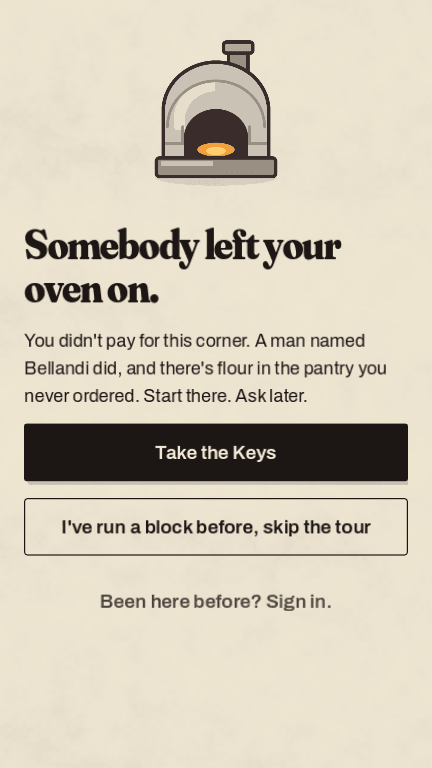
A gift arrives at every new oven on the Row. None of it is yours. The stamp on the sack reads Harbor Mills, and about a third of the time it adds that the stamp is a very good copy. You bake with it anyway, because the pantry is what you have.
- 02
What you're asking
Set a price a few percent over the going rate, or under it. Ten minutes later the street answers with a number: the block wanted 72 loaves, you filled 9, seven other shops filled 32, and 31 people went home with nothing.
- 03
The book
Ingredients and finished goods trade on a real market. You can see every price people are offering to buy at, and every price they will sell at, all the way down. A limit is not a promise. It fills at your price or better, it waits for somebody to take it, or it runs out of time.
- 04
Stale, not gone
Bread does not stay fresh. Nothing on your shelf is destroyed for being old either: value follows a curve down towards a floor, so a two-day-old boule still sells, for less. Less is not nothing.
- 05
The block
You never learn who sold you flour. You always know who opened across from you. Every shop on your block has a name, a storefront and a share of the day, and the Crier prints what happened at six every morning. Nobody proofreads it twice.
- 06
The outfit
Ossia and Sons keep a shared larder anybody at the table can empty, and that includes you. A war is takings against takings over three days, and the board shows both totals the whole way. Nothing can be taken for good.
Screens
The real game, not concept art
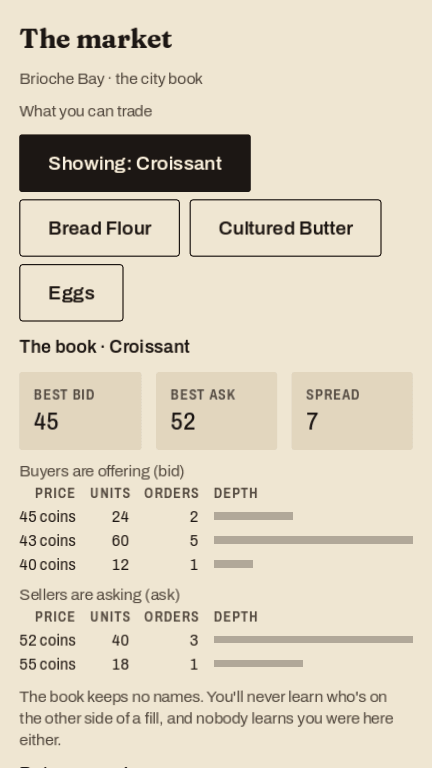
A real market, with a price to buy at and a price to sell at.
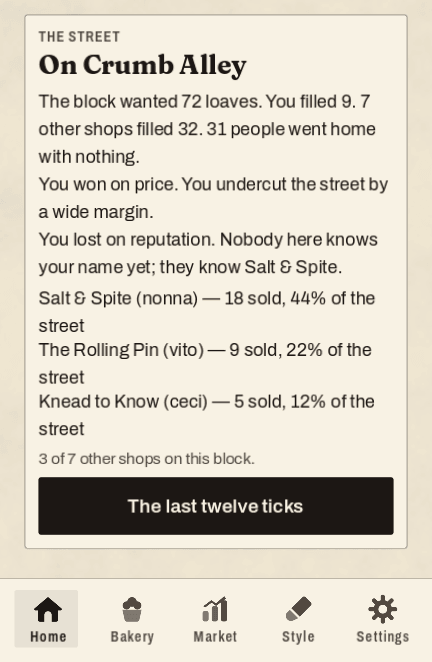
You won on price. You lost on reputation.
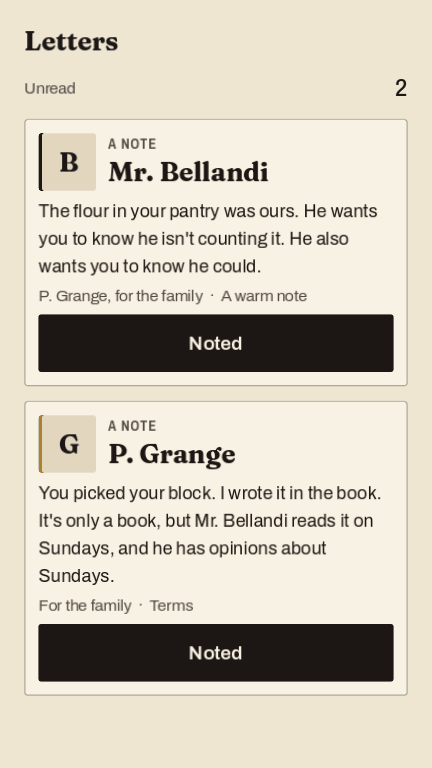
He isn't counting the flour. He could.
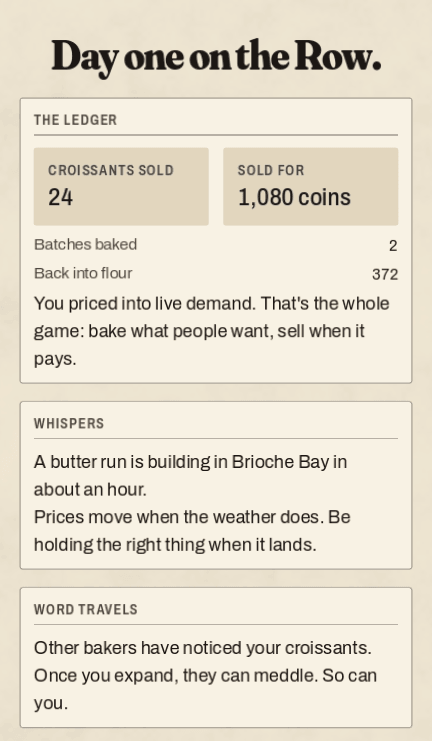
Twenty-four croissants, 1,080 coins, other bakers noticed.
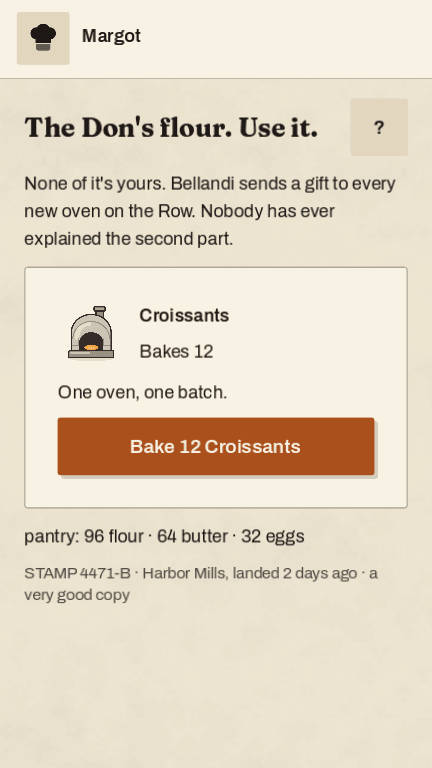
The stamp is a very good copy.
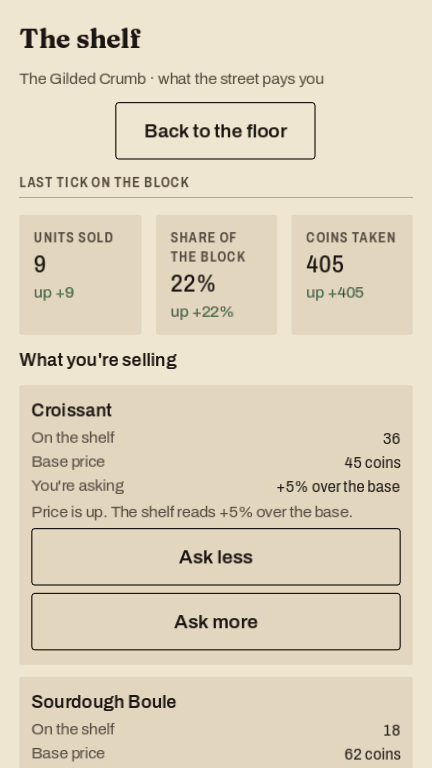
Asking five percent over the base price.
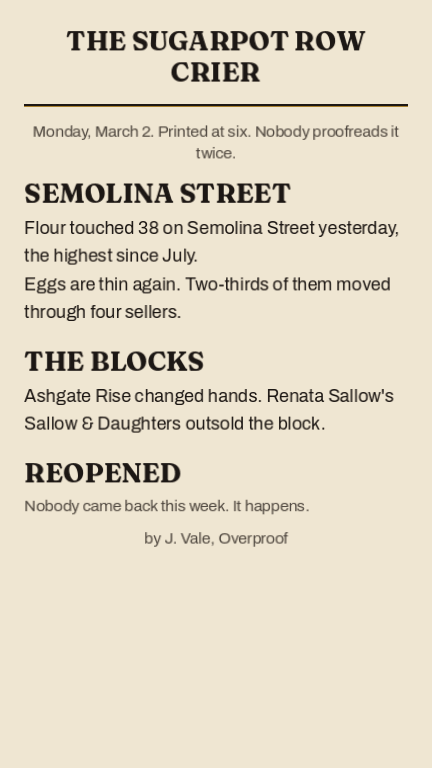
The Row's paper, printed at six.
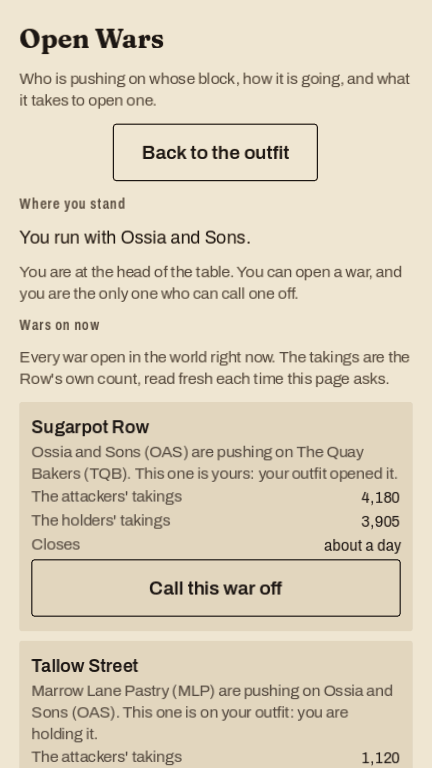
The outfit's war, scored in takings.
Questions
Before you install it
Where do I get it?
Google Play, free, on Android phones. The badge at the top of this page opens the listing.
What does it run on?
Android phones. You play it with one hand, on a bad phone, on the bus. Nothing in it needs fast fingers, and there is no moment you can miss by being slow.
The game signs you in as a guest. No account to make, no password, and no Google sign-in.
Is there anything to buy, and does it buy wins?
Crystals are the only thing sold. They buy an oven slot, by the week or outright; a bake finished early; and things to look at — an apron, a shopfront sign, a hat, a letterpress recipe card. Crystals never turn into coins and never buy a win off anybody, and nothing bought this way can be taken off you by another player.
No purchase in the game resolves at random. The rare-ingredient crate is the only thing that could roll, and it does not: it holds three ingredients and gives you all three, every time. The shop will not sell you one either. Nothing on the shelf deals you a hand at one of the games, re-deals one, or changes how one scores.
One game would be dealt by a bake, and it is switched off. No bake a shipped oven can run is long enough to open it anyway. If it is ever turned on, more ovens will mean more hands a day, and whether that sits inside the rule is an open call.
Is all of it switched on?
No. Nine of the sixteen are on when you first play. Seven are built and switched off, and each one has a reason. The rest go on over the weeks after this one.
The screens below are frames from the running build either way. The one showing something switched off says so under it.
Which nine, and which seven
On: the stamps on the flour, the letters, the six-ten card, the Crier. Then five of the games: the whisper you overhear, the haul you share, the buyer at the back door, the books you go over for a rebate, and the jobs you take on the side.
Off: the day-old rack, which has no screen in the app yet. The cannoli box, which needs an account fourteen days old, so nobody can be sent one for another two weeks. Nobody opens your shutters for you until a block has been dark a month. The letter-delivery game, the signature-goods lineage, the batch game and the walkthrough are each waiting on content, on a bake long enough to interrupt, or on a screen that explains what it did to your oven.
None of it is part of the download, so nothing here needs you to update the app. They go on from our end.
Can another player take my bakery?
No. A rival can undercut you, outsell you on your own block and put a bounty on you on the Grudge Board. What any of it costs you is time and reputation, and both come back.
Nobody can take your shop, your stock or your money. Not ever, and not by any route. It is a rule, not a matter of tuning.
What happens while I'm not playing?
The street keeps moving while you are away. Close the app mid-bake if you like; the clock is not on your phone. You come back to a ledger of what the block did.
Freshness is a curve with a floor under it rather than a cliff: value falls, then stops, and nothing on your shelf is destroyed for being old. That landed in the server in August 2026 and it is on by default. No notification from this game will tell you to come back or lose something, and it asks for no notification permission at all.
Is this based on a real family or a real place?
No. Sugarpot Row, Brioche Bay, Crumb Alley, Mr. Bellandi, Ossia and Sons, the Commission and every rival named on this page were invented for the game. The fiction is PG-13 and the comedy comes from bookkeeping colliding with menace, never from an accent or an ethnicity.
Is it an idle game?
No. An oven fills a bar, and that is roughly the last thing that happens on its own. Every number on the shelf came from a price you chose against every other shop on the block, each of which chose one too, and the panel names the factor you won on and the one you lost on.
Who made it
An offer I could not refuse either
Every family has a business. This one is mine, and I run it alone.
I built it because the baking games I could find all made the same promise and broke it. They give you a counter, a timer, and a neighbour who is a number going up while you watch. Nobody on the other side of the sale. Nobody to beat.
So I put people there. The shop next door reads your price and goes under it. You do the same back to them. That is the arrangement, and everything else in the game is there to hold it up.
You have my word on the one thing worth having it on. Nobody takes your shop, your stock or your money. Not me, not a rival, not a bad week. That is a rule, and rules are the only thing I am sentimental about.
If something is broken, or you found a way to win that I did not see coming, write to me at support@bakerywars.com. It is my mailbox, not a queue. I read all of it and I forgive most of it.
Don Amato
Where to get it
It is on Google Play
Free to install, on Android phones. You are signed in as a guest, so nothing is asked of you before you bake.